May
Vertical Farming Systems: The Complete Guide to Vertical Farming Systems
For the last several millennia, the “expansion” of agriculture has been horizontal. If a civilization needed more food, it cleared more forests, plowed more plains, and pushed its borders outward. But as we navigate the complexities of 2026, we are hitting a physical wall. Arable land is disappearing due to urbanization and climate degradation, while the global population continues its upward march toward 10 billion.
The solution? We stop looking at the horizon and start looking at the sky. Vertical Farming (VF) is the practice of growing crops in vertically stacked layers or on vertically inclined surfaces. It is the ultimate expression of Controlled Environment Agriculture (CEA), turning the “Urban Jungle” into a literal one. This guide explores the architecture, technology, and economic realities of farming in the third dimension.

1. The Architecture of the Ascent: How Vertical Farming Works
At its core, a vertical farm is a closed-loop ecosystem housed within a building. Unlike a traditional greenhouse, which still relies primarily on the sun, a vertical farm is often completely decoupled from the outside world. This allows for total environmental sovereignty.
The Stacking Logic – Vertical Farming Systems
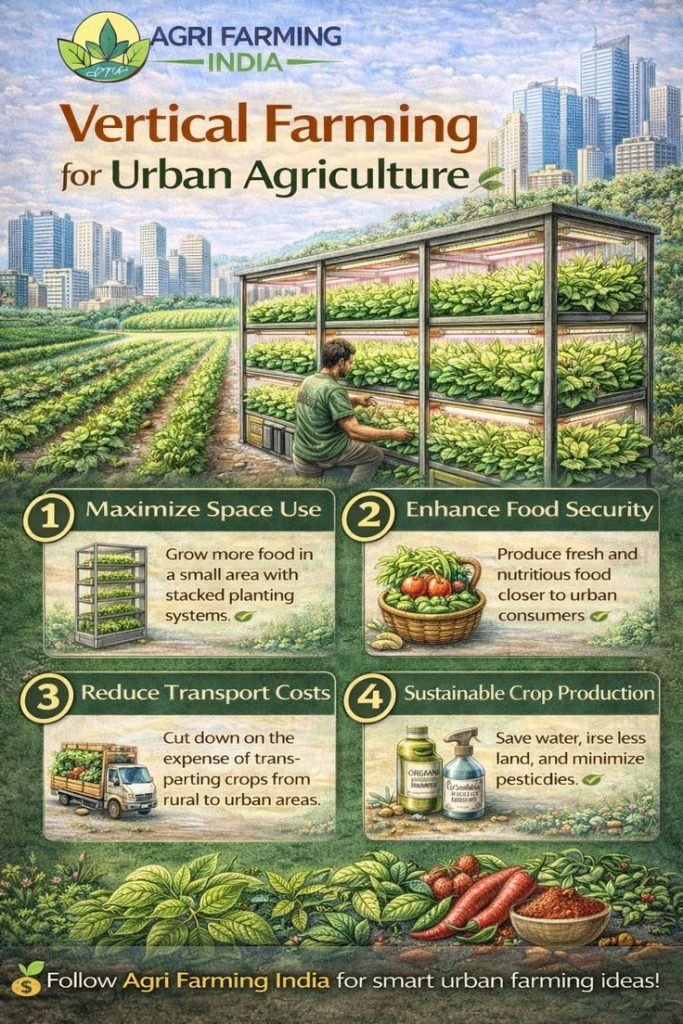
Vertical farms utilize high-density racking systems that can reach from the floor to the ceiling of a warehouse or a purpose-built skyscraper. This “layering” effect allows a one-acre building to produce the equivalent yield of 10 to 20 acres of traditional farmland, depending on the crop.
Comparison: Vertical vs. Traditional Farming
| Feature | Traditional Farming | Vertical Farming |
| Land Use | High (Extensive) | Low (Intensive) |
| Water Efficiency | 10–40% (Loss to runoff/evap) | 95% + (Recycled) |
| Climate Dependence | Seasonal / Weather-dependent | Year-Round (365 days) |
| Pesticide Use | High (Soil-borne pests) | Zero to Minimal (Sterile) |
| Logistics | Thousands of “Food Miles” | Local (City Centers) |
2. The Tech Stack: The Engines of Vertical Growth
A vertical farm is less of a “field” and more of a “factory.” It relies on a sophisticated stack of technologies to mimic—and then improve upon—nature.
I. Lighting: The Artificial Sun
Since most vertical farms are indoors (often in windowless warehouses), the plants never see the sun. Instead, they rely on LED (Light Emitting Diode) arrays.
The Light Recipe: Plants don’t need the full spectrum of sunlight to thrive. Vertical farms often use “pink” or “purple” light—a specific combination of Red and Blue wavelengths—which are the most efficient for photosynthesis.
PAR (Photosynthetically Active Radiation): Farmers measure light not in “brightness” but in PAR, which represents the spectral range of solar radiation from 400 to 700 nanometers that photosynthetic organisms use.
II. Soilless Cultivation: Hydro, Aero, and Aqua
Soil is heavy, messy, and a breeding ground for pests. Vertical farms almost exclusively use “soilless” methods:
Hydroponics: Roots are submerged in or misted with nutrient-rich water.
Aeroponics: Roots are suspended in the air and misted with a nutrient solution. This is the most efficient method, as it provides the roots with maximum oxygen exposure.
Aquaponics: A hybrid system where fish waste provides the nutrients for the plants, and the plants filter the water for the fish.
III. Climate and Atmosphere Control
In a vertical farm, the “weather” is programmed.
HVAC-D: High-efficiency heating, ventilation, air conditioning, and dehumidification systems are the heart of the farm. They manage the Vapor Pressure Deficit (VPD), ensuring plants can “breathe” (transpire) properly.
CO2 Enrichment: Because the environment is sealed, farmers can raise $CO_2$ levels higher than the outside atmosphere, significantly accelerating growth rates.

3. The Benefits: Why the World is Scaling Up
I. Hyper-Local Food Security
By placing farms in the hearts of cities (like New York, Tokyo, or Da Nang), we eliminate the “Food Miles” problem. A head of lettuce in a traditional system might travel 2,000 miles in a refrigerated truck before reaching your plate. In vertical farming, that distance is measured in city blocks. This ensures peak freshness and reduces the carbon footprint of transport.
II. Drastic Water Conservation
Agriculture is responsible for roughly 70% of global freshwater use. Vertical farms use a “closed-loop” irrigation system. Any water that the plant doesn’t drink, or that evaporates into the air, is captured by dehumidifiers, filtered, and put back into the reservoir. The result is a 90% to 95% reduction in water usage compared to field farming.
III. The End of Seasonality
In a vertical farm, it is always the perfect spring day. This allows for continuous harvesting. For leafy greens, this can mean 15 to 22 harvests per year, compared to the 2 or 3 possible in an outdoor field.
4. The Challenges: The “Reality Check” of Vertical Growth
If vertical farming is so efficient, why isn’t every building a farm? The challenges are primarily economic and energetic.
I. The Energy Penalty
The biggest “cost” in traditional farming is land; the biggest cost in vertical farming is electricity. Replacing the sun with LEDs and running industrial-scale HVAC systems 24/7 is incredibly energy-intensive.
The efficiency of a vertical farm is often measured by its Energy Usage Intensity (EUI):
Until renewable energy (Solar/Wind) becomes even cheaper, the carbon footprint of the electricity used can sometimes outweigh the benefits of the saved food miles.
II. High Initial CAPEX
Building a vertical farm is an expensive engineering project. The costs for sensors, automation, LED arrays, and sterile infrastructure mean that the “Capital Expenditure” (CAPEX) is significantly higher than buying or leasing flat land. This is why most vertical farms currently focus on high-value crops (herbs, leafy greens, microgreens) rather than low-margin staples like wheat or corn.
III. The Technical Skill Gap
You don’t just need a farmer; you need a systems engineer, a data scientist, and a chemist. Managing the complex “nutrient recipes” and the automated robotics requires a workforce with high-level technical training.
5. Future Trends: AI and Robotic Harvesting
The future of vertical farming lies in Total Automation.
AI Vision: Cameras and AI algorithms monitor every leaf for signs of stress or disease, allowing for “micro-adjustments” to the nutrient flow or light intensity for a single plant.
Robotic Harvesters: Because the plants are in a predictable, geometric grid, robots can easily handle the seeding, transplanting, and harvesting, reducing labor costs—the second-largest expense after energy.
Circular Integration: We are seeing “Smart Buildings” where the waste heat from a data center is used to warm a vertical farm, and the oxygen produced by the farm is pumped back into the office spaces.
6. Frequently Asked Questions (FAQ)
Q: Can we grow wheat or rice vertically?
A: Technically, yes. Economically, no. High-calorie staples grow too slowly and require too much light per calorie produced to be profitable in a high-rent vertical farm setup… for now.
Q: Is the food “Organic”?
A: This is a point of debate. In many regions, “Organic” certification requires the use of soil. However, vertical farm produce is arguably “cleaner” than organic food because it is grown in a sterile environment with zero pesticides or herbicides.
Q: Does vertical farming replace traditional farming?
A: No. It is a complementary system. Vertical farms handle the perishable, high-value greens for cities, while traditional farms focus on the massive quantities of grains and livestock needed to feed the world.

Conclusion
Vertical farming is the ultimate convergence of biology and technology. It represents a shift from “extraction-based” agriculture to “production-based” agriculture. While the energy challenges are real, the move toward greener grids and more efficient LEDs is making the “Sky Farm” more viable every day.
In a world where we can no longer afford to waste water or land, the ability to grow food in the heart of the city, regardless of the weather outside, is more than just a cool piece of tech—it is a vital pillar of our future food security. As we continue to refine the “Digital Harvest,” vertical farming will move from a niche innovation to a global necessity.
Are you interested in the technical side of these systems? Given the high energy costs, do you think the future of vertical farming lies in specialized “farm-only” buildings, or in integrating “mini-farms” into existing residential and office skyscrapers?
