May
Water Pumps for Agriculture: A Comprehensive Guide to Agricultural Water Pumps
In the grand theater of agriculture, if soil is the stage and seeds are the actors, then water is the lifeblood that keeps the performance going. However, water rarely sits exactly where you need it. Unless your farm is blessed with a natural gravity-fed spring, you are in the business of moving mass against gravity.
In 2026, a water pump is no longer just a “dumb” piece of iron; it is a precision instrument. Choosing the wrong pump is like putting a lawnmower engine in a semi-truck—it might move, but it won’t be efficient, and it certainly won’t last. This guide explores the mechanical, electrical, and strategic dimensions of agricultural water pumps, ensuring you have the “pressure” to succeed.
1. The Physics of the Pull: How Pumps Work
To select the right pump, we have to respect the laws of thermodynamics. A pump doesn’t “suck” water; it creates a pressure vacuum that allows atmospheric pressure to push water into the pump.
The Power Equation – Water Pumps for Agriculture
When calculating the energy required to move water, engineers use the following formula to determine the Hydraulic Power ($P_h$):
Where:
$Q$ = Flow rate (cubic meters per second, $m^3/s$)
$H$ = Total Dynamic Head (meters, $m$)
$rho$ = Density of water ($approx 1000 , kg/m^3$)
$g$ = Acceleration due to gravity ($approx 9.81 , m/s^2$)
Understanding this relationship is vital: if you want to double your flow ($Q$) or double the height you’re pumping ($H$), you must double your power input.
2. The Main Players: Types of Agricultural Pumps
There is no “perfect” pump, only the right pump for a specific water source.
I. Centrifugal Pumps (The Surface Workhorse)
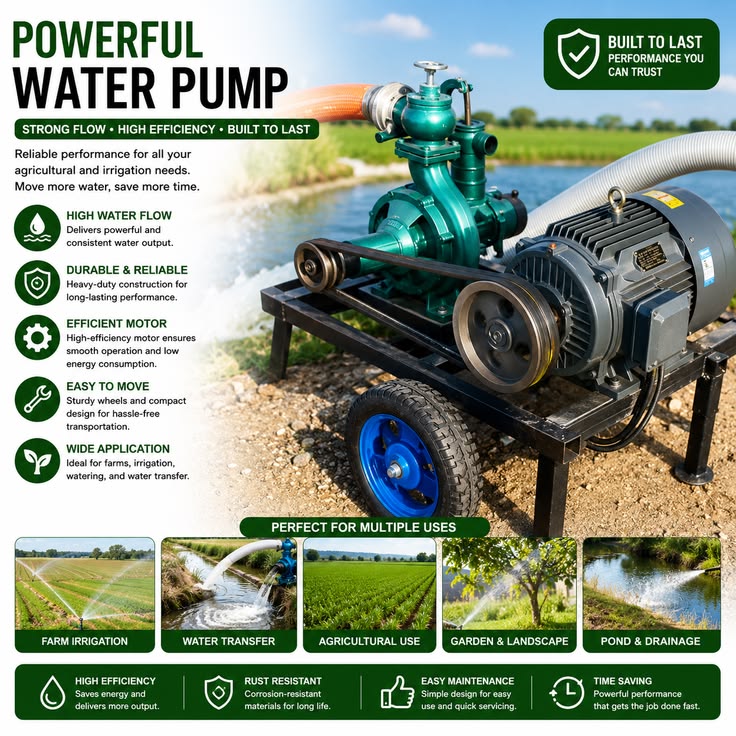
The centrifugal pump is the most common variety in global agriculture. It uses a rotating impeller to create centrifugal force, flinging water outward and creating the pressure needed to move it through the pipes.
Best For: Pulling water from shallow sources like ponds, lakes, or storage tanks.
The Limitation: They struggle with “Suction Lift.” If the pump is more than 7–8 meters above the water level, it will likely lose its “prime” (the water column inside the pump) and stop working.
II. Submersible Pumps (The Deep Divers)
When your water is 100 meters underground in an aquifer, a surface pump is useless. Submersible pumps are long, thin cylinders designed to be dropped directly down a well casing. They are “multi-stage,” meaning they have multiple impellers stacked on top of each other to build immense pressure.
The Advantage: Because they are pushed by the water rather than pulling it, they are incredibly efficient at moving water from extreme depths.
The Benefit: They are silent and protected from the elements (and thieves) deep underground.
III. Solar-Powered Pumps (The Eco-Revolution)
In 2026, the cost of Photovoltaic (PV) panels has dropped so significantly that solar pumping is often cheaper than running a diesel generator. Solar pumps use a DC motor or a Variable Frequency Drive (VFD) to convert sunlight into water flow.
The Logic: You usually need the most water when the sun is shining the brightest (hot days). Solar pumps align perfectly with the plant’s peak transpiration needs.
The “Battery” Hack: Instead of expensive electrical batteries, smart farmers use “Gravity Batteries”—pumping water into a high-elevation tank during the day and letting it flow down via gravity at night.
3. Comparison of Pump Technologies
| Feature | Centrifugal | Submersible | Solar (PV) |
| Water Source | Surface (Pond/Tank) | Deep Well / Borehole | Any (requires specific motor) |
| Initial Cost | Low | Medium to High | High (Panels + Pump) |
| Operating Cost | High (Electricity/Fuel) | Medium | Near Zero |
| Maintenance | Easy (Surface access) | Hard (Requires pulling) | Low |
| Efficiency | Medium | High | High (using DC motors) |
4. Selection Criteria: Factors to Consider
Don’t buy a pump based on “Horsepower” ($HP$) alone. That’s a marketing number. Instead, look at your Pump Curve.
I. Total Dynamic Head (TDH)
This isn’t just the height of the hill. TDH is the sum of:
Static Head: The vertical distance the water must travel.
Friction Loss: The “drag” the water feels as it rubs against the inside of the pipes.
Pressure Head: The pressure required at the end of the line (e.g., to pop up a sprinkler head).
II. Power Availability
Electric: The most reliable and easiest to automate, but requires a power line near the water source.
Diesel/Gasoline: Portable and powerful, but expensive to run and requires constant refueling.
Solar: Best for remote areas, though it requires a backup plan for cloudy weeks.
III. Water Quality
Are you pumping clean well water or silty pond water?
Clean Water: Standard impellers work fine.
Sandy/Trash Water: You need a Trash Pump or a pump with a “Semi-Open Impeller” that can pass solids without clogging.
5. The Strategic Benefits of a Modern Pump System
Investing in a high-quality pump system isn’t just about “getting wet.” It’s about operational control.
Automation Readiness: Modern pumps can be linked to IoT soil sensors. When the soil moisture drops below 15%, the pump starts automatically. This ensures the plant never enters “stress mode.”
Fertigation Support: High-pressure pumps are necessary to inject liquid fertilizers into the irrigation line, ensuring every plant gets fed while it gets watered.
Consistency: Unlike rain, a pump doesn’t have “bad years.” Having a reliable pump is the ultimate insurance policy against climate volatility.
6. Maintenance: Preventing the “Dry Run”
The fastest way to kill a pump is to let it run without water. Water acts as a coolant and a lubricant for the internal seals. Without it, the friction creates enough heat to melt the seals in minutes.
Install a Low-Water Cutoff: This sensor turns the pump off if the water source runs dry.
Check the Foot Valve: This is the one-way valve at the bottom of the pipe that keeps the pump “primed.” If it leaks, your pump will be spinning air.
Grease and Bearings: For surface pumps, a quarterly check of the bearings can prevent a catastrophic motor failure.
7. Common Mistakes to Avoid
Under-sizing the Pipe: If your pump is powerful but your pipes are too narrow, the “Friction Loss” will eat up all your pressure. It’s like trying to breathe through a cocktail straw while running a marathon.
Ignoring NPSH: Net Positive Suction Head. If the pressure at the pump inlet drops too low, the water will literally “boil” at room temperature, creating tiny bubbles that implode and eat away at the metal (a process called Cavitation). If your pump sounds like it’s pumping marbles, you have a cavitation problem.
No Protection: Leaving a $2,000 submersible pump unprotected from electrical surges is a recipe for disaster. Always use a high-quality control box with surge protection.
8. The Future: Variable Frequency Drives (VFDs)
The biggest innovation in agricultural pumping is the VFD. In the past, pumps were either “On” (100% power) or “Off.” If you only needed a little water, the pump still ran at full speed, and you “choked” the flow with a valve—which is a massive waste of energy.
A VFD acts like a dimmer switch for your pump. It adjusts the motor speed to match the exact demand of the irrigation system. This can reduce energy costs by 30–50% and significantly extends the lifespan of the motor.
Conclusion
A water pump is the “Heart” of the farm’s circulatory system. While it’s easy to focus on the “Frontend” of farming—the crops and the tractors—the “Backend” infrastructure of water management is what truly dictates your yield potential.
By understanding your Total Dynamic Head, selecting the right pump architecture for your source, and embracing modern control technologies like VFDs and Solar, you move from “surviving” the season to “optimizing” it. In an era of increasing water scarcity, the farmer who moves water most efficiently is the farmer who wins.
Are you ready to prime your system? Considering your current water source, do you think a surface centrifugal pump would suffice, or does the depth of your local water table necessitate the move to a submersible system?
