May
Best Irrigation Systems for Farms
Introduction
Water is one of the most essential resources in agriculture. Without proper water management, even the most fertile soil and high-quality seeds cannot guarantee a successful harvest. As global water scarcity becomes more severe and climate patterns become less predictable, farmers must adopt efficient irrigation systems to ensure consistent crop production.
Irrigation systems allow farmers to control the amount, timing, and distribution of water across their fields. This not only improves crop yield but also reduces water waste and protects soil health. Choosing the right irrigation system is therefore a critical decision for both small-scale and large-scale farmers.
In this article, we will explore the best irrigation systems for farms, their advantages and disadvantages, and how to select the most suitable option for your agricultural needs.

What Is an Irrigation System?
An irrigation system is a method used to supply water to crops artificially, ensuring they receive adequate moisture regardless of rainfall conditions. It plays a vital role in modern agriculture by stabilizing production and improving efficiency.
A well-designed irrigation system helps:
- Maintain consistent soil moisture
- Support plant growth and development
- Increase crop yield and quality
- Reduce dependency on natural rainfall
- Optimize water usage
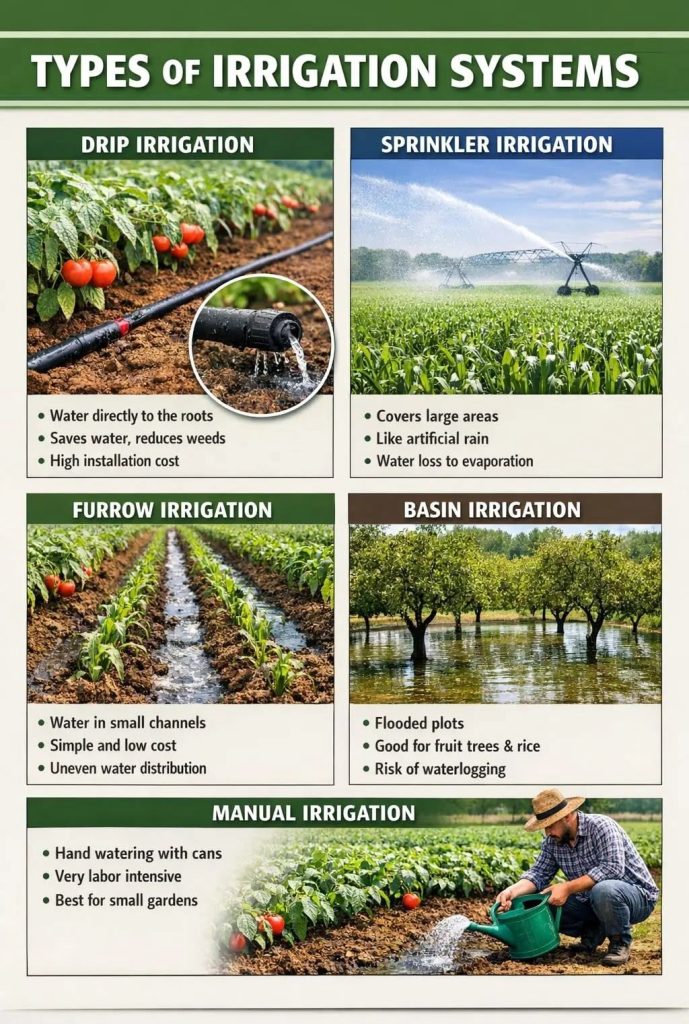
Types of Irrigation Systems
1. Drip Irrigation System
Drip irrigation is widely considered the most efficient irrigation method available. It delivers water directly to the root zone of plants through a network of pipes, tubes, and emitters.
Advantages:
- Extremely water-efficient (up to 90?95%)
- Minimizes evaporation and runoff
- Reduces weed growth
- Allows precise nutrient delivery (fertigation)
Disadvantages:
- High initial installation cost
- Requires regular maintenance to prevent clogging
Drip irrigation is ideal for vegetables, fruit crops, orchards, and greenhouse farming.
2. Sprinkler Irrigation System
Sprinkler systems simulate natural rainfall by spraying water into the air through nozzles. They are commonly used in medium to large farms.
Advantages:
- Suitable for a wide range of crops
- Easy to install and operate
- Covers large areas efficiently
Disadvantages:
- Water loss due to wind and evaporation
- Can lead to leaf diseases if overused
Sprinkler irrigation works well for crops like wheat, corn, and grasslands.
3. Surface Irrigation
Surface irrigation is one of the oldest methods, where water flows over the soil surface by gravity.
Types include:
- Flood irrigation
- Furrow irrigation
- Basin irrigation
Advantages:
- Low cost and simple design
- Requires minimal equipment
Disadvantages:
- High water wastage
- Uneven water distribution
- Risk of soil erosion
This method is still widely used in traditional farming systems.
4. Subsurface Irrigation
Subsurface irrigation delivers water below the soil surface directly to plant roots using buried pipes.
Advantages:
- Eliminates evaporation losses
- Improves water-use efficiency
- Reduces weed growth
Disadvantages:
- Expensive installation
- Difficult to repair and maintain
This system is suitable for high-value crops and advanced farming operations.

5. Center Pivot Irrigation
Center pivot irrigation uses a rotating system of pipes and sprinklers that move in a circular pattern around a central pivot point.
Advantages:
- Ideal for large-scale farms
- Automated and labor-saving
- Uniform water distribution
Disadvantages:
- High setup cost
- Not suitable for irregularly shaped fields
It is commonly used in countries with large agricultural lands.
Factors to Consider When Choosing an Irrigation System
1. Crop Type
Different crops have different water requirements. For example:
- Vegetables ¨ Prefer drip irrigation
- Grains ¨ Suitable for sprinkler systems
- Rice ¨ Often uses flood irrigation
Understanding crop needs is essential for selecting the right system.
2. Soil Type
Soil characteristics influence water absorption and retention:
- Sandy soil ¨ Drains quickly, needs frequent watering
- Clay soil ¨ Retains water longer, requires less frequent irrigation
Choosing a system that matches soil conditions improves efficiency.
3. Climate and Weather
Hot and dry climates increase evaporation, making efficient systems like drip irrigation more suitable. In windy areas, sprinkler systems may lose effectiveness.
4. Water Availability
Farmers must evaluate their water source, whether it is groundwater, rivers, or reservoirs. Limited water supply requires highly efficient systems.
5. Budget and Investment
While some irrigation systems have high initial costs, they often save money in the long run through reduced water usage and increased productivity.
Benefits of Modern Irrigation Systems
1. Water Conservation
Efficient irrigation systems significantly reduce water wastage, making them essential in regions with limited water resources.
2. Increased Crop Yield
Consistent water supply leads to healthier plants and higher yields.
3. Reduced Labor Costs
Automation reduces the need for manual irrigation, saving time and labor.
4. Improved Fertilizer Efficiency
Many systems support fertigation, allowing fertilizers to be delivered directly to plant roots for maximum effectiveness.
5. Better Crop Quality
Uniform watering results in crops with better size, color, and nutritional value.
Common Mistakes to Avoid
Farmers often reduce irrigation efficiency by making avoidable mistakes such as:
- Overwatering crops
- Using the wrong irrigation system for the soil
- Ignoring system maintenance
- Poor layout design
- Not monitoring water usage
Avoiding these issues can significantly improve farm performance.
Smart Irrigation Technologies
Modern agriculture is increasingly adopting smart irrigation technologies, including:
- Soil moisture sensors
- Weather-based irrigation controllers
- Automated irrigation scheduling
- Mobile app monitoring systems
These technologies allow farmers to make data-driven decisions and optimize water usage.
Drip vs Sprinkler Irrigation
| Feature | Drip Irrigation | Sprinkler Irrigation |
|---|---|---|
| Water Efficiency | Very High | Medium |
| Installation Cost | High | Moderate |
| Maintenance | Moderate | Low |
| Best Use | Fruits, vegetables | Grains, lawns |
Real-World Applications
Many farms around the world have successfully improved productivity by adopting modern irrigation systems. For example, farmers using drip irrigation in dry regions have reported significant water savings and increased crop yields.
Similarly, large-scale farms using center pivot systems benefit from automation and consistent irrigation, reducing labor costs and improving efficiency.
Future of Irrigation in Agriculture
The future of irrigation lies in precision and sustainability. Technologies such as artificial intelligence (AI), Internet of Things (IoT), and satellite monitoring are transforming how farmers manage water.
Smart irrigation systems will continue to evolve, helping farmers optimize resources, reduce waste, and increase productivity.
Frequently Asked Questions (FAQ)
Which irrigation system is the most efficient?
Drip irrigation is considered the most efficient because it delivers water directly to plant roots with minimal loss.
Is sprinkler irrigation suitable for all crops?
No, sprinkler irrigation works best for crops like grains and grass but may not be ideal for delicate plants.
How can farmers reduce water usage?
Farmers can reduce water usage by adopting efficient irrigation systems, using sensors, and scheduling irrigation based on crop needs.
Conclusion
Choosing the right irrigation system is essential for modern farming. With increasing pressure on water resources, farmers must adopt efficient and sustainable irrigation methods.
From drip irrigation for precision farming to sprinkler systems for large fields, each method has its own advantages. The key is to match the system with crop type, soil conditions, and available resources.
By investing in the right irrigation system, farmers can improve productivity, conserve water, and ensure long-term agricultural success.
>tion
